Unveiling the Evolution of Afterglow in Diboraanthracene Scaffolds: From Thermally Activated Delayed Fluorescence to Room-Temperature Phosphorescence (Dept. Chemistry / Asst. Prof. Tien-Lin Wu)
Department: Department of Chemistry PI's Name: Tien-Lin Wu
Journal: Journal of the American Chemical Society, J. Am. Chem. Soc. 2025, 147, 45603–45617
Title: Unveiling the Evolution of Afterglow in Diboraanthracene Scaffolds: From Thermally Activated Delayed Fluorescence to Room-Temperature Phosphorescence
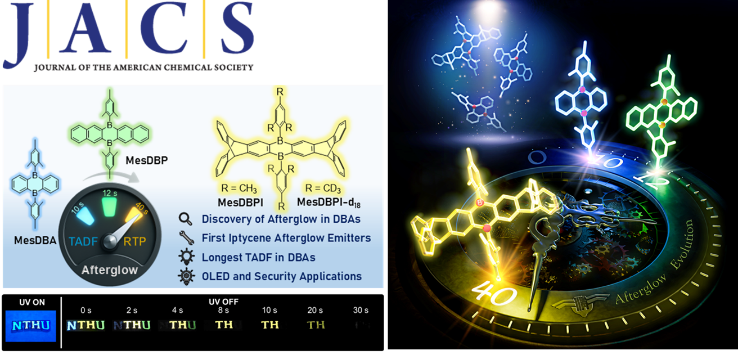
Abstract: Three-coordinate organoboron molecules have recently emerged as highly promising candidates for organic afterglow materials because the boron center can effectively promote intersystem crossing (ISC). In this work, we systematically investigate how structural modulation within the diboraanthracene (DBA) scaffold governs its emission pathways and reveal an evolution from thermally activated delayed fluorescence (TADF) to room-temperature phosphorescence (RTP). Remarkably, nearly thirty years after the initial synthesis of MesDBA, our team is the first to measure and report its ultralong TADF emission with a lifetime of 0.72 s, which represents the longest value reported among purely TADF systems. Extending the π-conjugation yields MesDBP, which activates a hybrid TADF and RTP pathway and provides afterglow emission lasting 12 seconds with a lifetime of 1.41 s. Incorporation of a rigid iptycene unit produces MesDBPI, which successfully suppresses nonradiative decay and results in an afterglow duration of 40 seconds. Its deuterated derivative MesDBPI-d18 further increases the TADF and RTP lifetimes to 4.00 and 4.22 s, respectively, setting records for organoboron molecules doped in PMMA. To clarify the underlying evolutionary mechanism, we combine excited-state spectroscopic characterization with calculations based on Marcus theory, and the calculated RISC rate constants show excellent agreement with experimental results.
In terms of applications, afterglow organic light-emitting diodes (OLEDs) fabricated with MesDBPI achieve an external quantum efficiency of 1.8%. These materials also enable tunable afterglow colors for information security, demonstrated using the letters NTHU as an anti-counterfeiting display. Overall, this study reveals a controllable TADF to RTP evolutionary pathway within the DBA framework and demonstrates afterglow lasting up to 40 seconds. The results highlight the strong potential of this molecular design strategy for next-generation optoelectronics, sensing, bioimaging, and information security applications.